



INTRODUCTION
A single glance, deadly as a curse, capable of changing destinies.
To modern ears, this sounds like the opening of a myth. But in ancient Greece it was closer to a warning. The evil eye, known as Baskania (βασκανία), was not simply a story people told around fires. It was a force many believed could shape the course of a life.
Dating back to the Classical period around the 6th century BC, the Greek evil eye belief held that envy or malice could travel through a person's gaze and attach itself to whoever was on the receiving end. The result could be misfortune, illness, or a life that suddenly began running against the grain. What makes this belief so fascinating is not only its age but how seriously it was taken. Artists, philosophers, and scholars all tried to understand what the evil eye was and how it worked.
WHAT IS THE GREEK EVIL EYE?
In Greek tradition, Baskania referred to the belief that a person could harm another simply through a look fueled by envy or ill will. The gaze itself was thought to act as a vehicle, transmitting negative influence from one person to another. What made the idea particularly unsettling was that it did not always require intent. A stranger admiring your child, a neighbor eyeing your harvest, or a rival glancing at your success could all set the evil eye in motion, often without the person casting it realizing what they had done.
Success, beauty, and visible good fortune were considered the greatest vulnerabilities. The more someone had to envy, the more exposed they were believed to be. Happiness, in ancient Greece, carried with it a quiet shadow of risk.
THE EVIL EYE IN DAILY GREEK LIFE
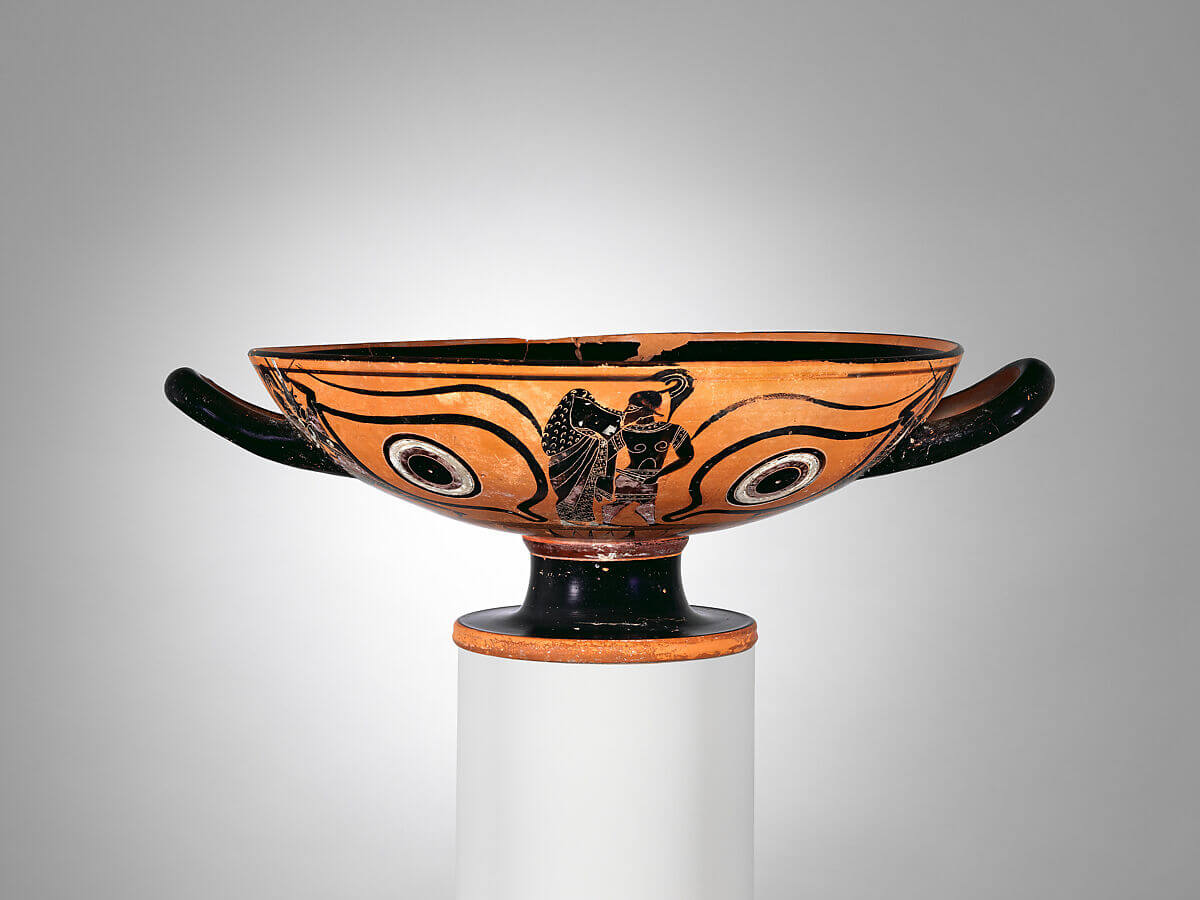
Fear of the evil eye was not confined to whispered superstition. It appeared openly in art, objects, and the rituals of everyday life. One of the most striking examples survives in the form of ancient drinking vessels known as eye cups. These cups were painted with large, bold eyes on their outer surface. When someone lifted the cup to drink, the painted eyes appeared to stare outward from the drinker's face.
Scholars believe these designs served a protective purpose. The painted eyes were thought to confuse or reflect back the evil gaze, meeting harmful attention with something equally powerful. They were not merely decorative. They functioned as a kind of symbolic armor. The fact that these images appeared on everyday objects tells us something important. Cups passed between friends at dinner or used during social gatherings carried protective imagery. The evil eye was not an abstract idea. Many people believed it was a force capable of shaping everyday life. It was a presence people believed could appear in ordinary moments.
WHEN SCHOLARS TOOK THE GAZE SERIOUSLY
Perhaps the most remarkable aspect of the Greek evil eye is that it attracted the attention of serious thinkers. It might sound strange today, but for many ancient thinkers the evil eye was not a superstition to dismiss. It was a puzzle worth explaining. The writer and philosopher Plutarch explored the idea with genuine curiosity. He proposed that the human eye might emit invisible rays and that intense emotions such as envy could charge those rays with harmful energy capable of producing real physical effects.
Rather than dismissing the evil eye as folklore, thinkers like Plutarch attempted to understand how such a force might work. Their explanations reflected the intellectual world of their time, when philosophy, early science, and mythology often overlapped. In exploring the idea, they blurred the boundary between observation and belief. The question was not simply whether the evil eye existed, but what mechanism might lie behind it.
THE CULTURAL LOGIC BEHIND THE FEAR
To understand why the Greeks feared the evil eye so deeply, it helps to consider how they viewed envy itself. Ancient Greek society was acutely aware of the dangers of standing out too much. Wealth, beauty, success, and praise were admired qualities, but they also made a person visible. Visibility invited envy, and envy was believed to carry consequences.
The evil eye gave those consequences a name and a form. It helped explain sudden illness, unexpected failure, or misfortune that appeared to arrive without a clear cause. At the same time, the belief encouraged humility and moderation. Boasting was not simply seen as impolite. In the eyes of many Greeks, it was genuinely dangerous.
THE EVIL EYE TODAY
Thousands of years have passed, yet the evil eye has never fully disappeared. Across the Mediterranean, the Middle East, and Latin America, the belief remains culturally significant. The familiar blue eye-shaped amulet worn as jewelry, hung above doorways, or given as gifts to newborns carries the same protective intention as those ancient eye cups. The form may be different, but the purpose remains the same.
In modern fashion and design the symbol has taken on a broader life. It appears in jewelry collections, interior design, and everyday accessories. Sometimes it functions as a spiritual talisman. Other times it appears simply as an aesthetic symbol. Yet even in its most secular forms, the symbol still carries an echo of its original meaning. In many cultures, protection from the evil eye is still sought through prayer or ritual practices that are believed to remove its effects and restore balance. The emotions the ancient Greeks feared have not disappeared, and the desire for protection from envy remains deeply human.
If you are curious about the signs that many traditions associate with being affected by the evil eye, and the remedies that have been passed down to address it, you can explore the signs and symptoms of the evil eye on this site.
CONCLUSION
The Greek evil eye remains one of history's most enduring ideas. Known as Baskania, it reflected a belief that envy could travel through the gaze and disrupt the balance of another person's life. From painted eye cups to philosophical speculation, the concept appeared throughout Greek culture. It shaped art, influenced social behavior, and inspired attempts to explain the unseen forces that seemed to affect human fortune.
Even today the symbol continues to appear around the world, carried in jewelry, charms, and stories. The idea persists because the emotions behind it remain familiar.
A single glance. The weight of envy. The search for protection. Some ideas, it turns out, are as old as human nature itself.
If you want to understand the historical origins of the evil eye, you can read our guide on the Greek evil eye and its ancient roots.


