


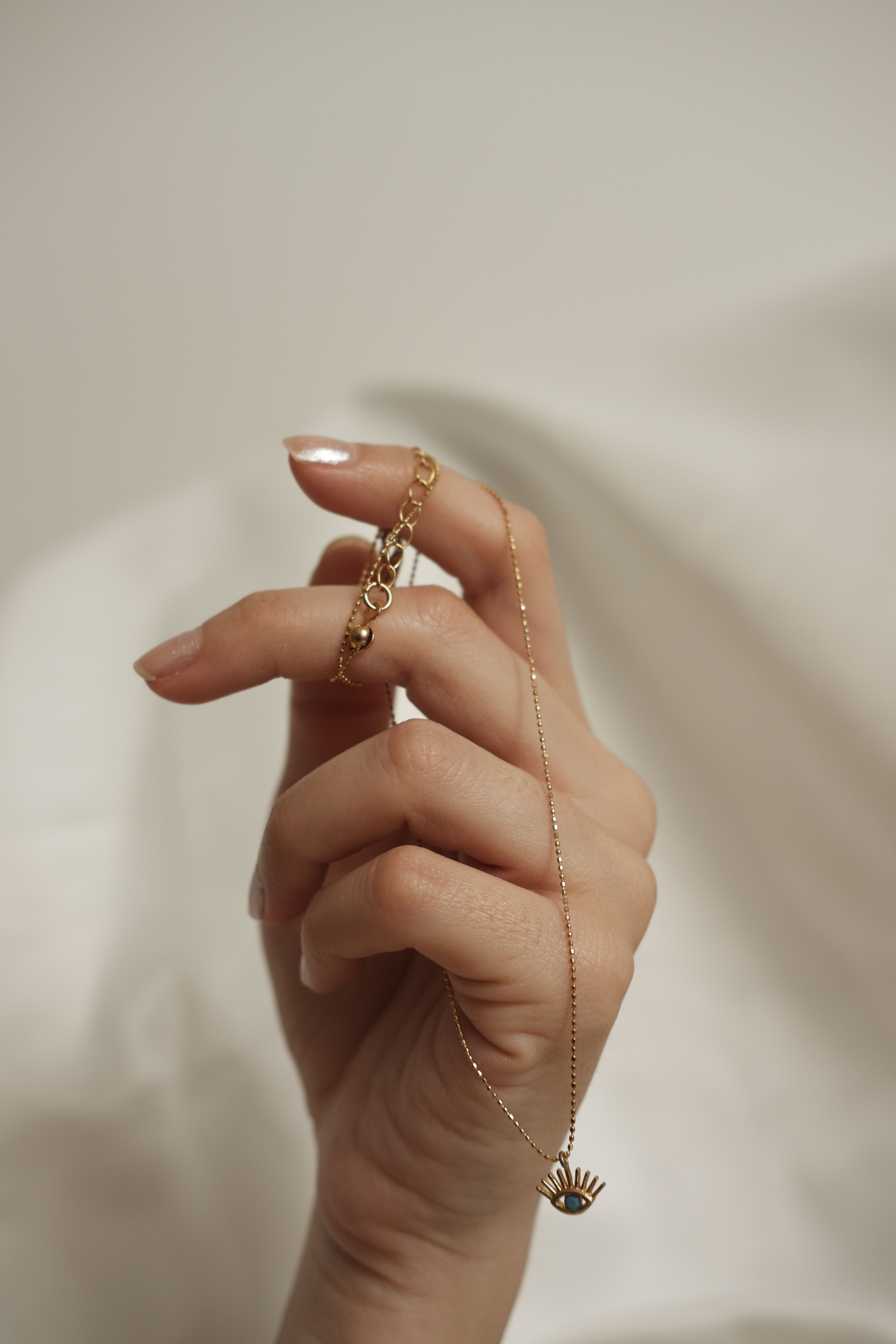

Imagine standing at a jewelry counter in Greece. You pick up a small blue eye on a delicate gold chain, turn it over in your palm, and hesitate. Not because of the price, but because somewhere in the back of your mind, you can almost hear your yiayia saying, “A mati should come from someone else.” So you put it down. Or you buy it anyway and feel faintly guilty all the way home.
It’s one of those traditions that some Greek families carry without ever writing it down. Ask ten Greek families whether you can buy your own mati, and you may get ten different answers, at least two of them delivered with a raised eyebrow.
Some insist a mati should be received as a gift. Others see no reason you can’t choose one yourself. And both sides have something to say.
The Case for Waiting
In some Greek families, a child’s first mati arrives before the baby is old enough to know what it means. A nona (godmother) gives a tiny blue charm. A grandmother brings a little bracelet. An aunt presents a pendant meant to be treasured for years.
The gift itself is part of the meaning. For families who follow this custom, a mati given with love carries the giver’s good wishes along with it. It isn’t just glass and color. It’s someone saying, “I’m looking out for you, even when I’m not there.”
In households where this belief is observed, protection is something offered between people, a gesture of affection and concern, rather than simply something you purchase for yourself. Sometimes, no one can explain exactly why the mati must be a gift. It’s just what their mother told them, and what her mother told her. That’s how many family traditions survive.
And it’s why some people hold onto a mati long after the cord has frayed or the clasp broken - it isn’t the object they’re keeping; it’s the person who gave it.
The Case for Buying Your Own
Then there’s the other camp. Plenty of people see absolutely no problem with buying their own mati. They’ll happily choose one for their wrists, their rearview mirrors, their front doors, and occasionally all three. For them, the meaning lies in the symbol, not necessarily in who paid for it.
Some choose a mati because they believe in its protective symbolism. Others wear one as a connection to Greek heritage, a reminder of someone they love, or simply because they find it beautiful. And what if you live far from family? Or you’ve just moved into a new home and want a little blue eye by the entrance?
Not everyone has a yiayia nearby waiting to hand them a charm. For many people, choosing their own mati is simply another way of keeping a familiar tradition alive.
The Loophole Everyone Can Agree On
Of course, some families have found a wonderfully practical solution: you pick it out, and someone else pays. A mother buys the bracelet her daughter has been admiring. Two friends choose matching charms and swap them at the register. A cousin “accidentally” buys one too many and hands you the extra. Technically, it’s a gift. Everyone’s happy. Yiayia is satisfied.
Silly as it sounds, the workaround captures something lovely about the tradition. The exchange becomes part of the story. A small blue charm turns into a shared memory, a gesture of affection, or an excuse to give someone something meaningful. And sometimes, that’s more important than the question of who bought it.
BougHt, Given, or Swapped at the Register
For some families, receiving a mati as a gift is an important part of its meaning. For others, buying one for yourself changes nothing. And for many, the little blue eyes is simply something a comforting reminder of home, family, or someone who wanted good things for them.
Alongside the mati, some Greek families also practice xematiasma, a traditional prayer used when they believe someone has been affected by the evil eye. It’s often passed down quietly from one generation to the next.
So buy your own if that’s what feels right. Wait for one if that’s how you were raised. Or give one to someone you love, simply because you want them to know you’re thinking of them. And if your yiayia insists you shouldn’t buy your own? Well, you already know the loophole.
Curious about the tradition beyond the blue charm? Learn more about xematiasma: the traditional Greek evil eye prayer.


