



INTRODUCTION
Imagine living in a world where a single jealous glance could bring illness, bad luck, or sudden misfortune. In the ancient Mediterranean, this was not a strange superstition. It was a widely accepted belief. People across Greek and Roman society worried about the mysterious force known as the evil eye.
According to tradition, envy or ill will directed toward another person could take the form of a harmful gaze. That gaze was believed to disrupt a person’s health, fortune, or peace of mind. The belief crossed social boundaries. Wealth, beauty, success, and recognition could all attract attention. And attention, people believed, could easily turn into envy. Because of this, ancient cultures developed rituals and symbols meant to protect themselves. Ancient cultures developed rituals, symbols, and small gestures meant to guard against the unseen effects of jealousy. These traditions reveal how seriously ancient societies viewed the emotional forces that shape human life.
WHAT IS THE EVIL EYE?
Fundamentally, the evil eye is the belief that someone can cause harm simply by looking at another person with envy or ill intent. In many traditions, the gaze itself is thought to carry destructive energy capable of affecting another person's health, luck, or well-being. The idea often appears where admiration and jealousy meet. Someone’s beauty, success, or good fortune may attract praise. But admiration can easily shift into resentment. Ancient cultures were deeply aware of this tension. The evil eye offered a way to explain sudden misfortune while also acknowledging how powerful envy could be within human relationships. For many societies, the evil eye was not dismissed as superstition. It was treated as a real social and spiritual danger.
THE EVIL EYE IN ANCIENT GREEK BELIEF
In ancient Greece, the evil eye was known as Baskania (βασκανία). The word described the belief that envy could produce a harmful influence capable of affecting another person's health, prosperity, or happiness. The concept has deeper roots in earlier Mediterranean traditions, which you can explore further in the ancient origins of the evil eye. Greek writers occasionally reflected on this idea when discussing the dangers of human emotion. The Greek word phthonos referred to jealousy or resentment toward another person’s success. It was considered one of the most destructive impulses a person could feel. Because of this, Greeks were often careful about displaying their achievements too openly. Drawing too much attention to wealth or success could provoke envy and, according to tradition, attract the evil eye.
Even those most admired by society were believed to be vulnerable. Victorious athletes, respected leaders, and prosperous citizens all attracted attention. And attention, people believed, could invite unseen harm. For that reason, protective customs became a normal part of everyday Greek life.
PROTECTIVE SYMBOLS USED IN GREEK TRADITION
To guard against the evil eye, the Greeks turned to powerful symbols believed to repel negative energy and deflect harmful attention.
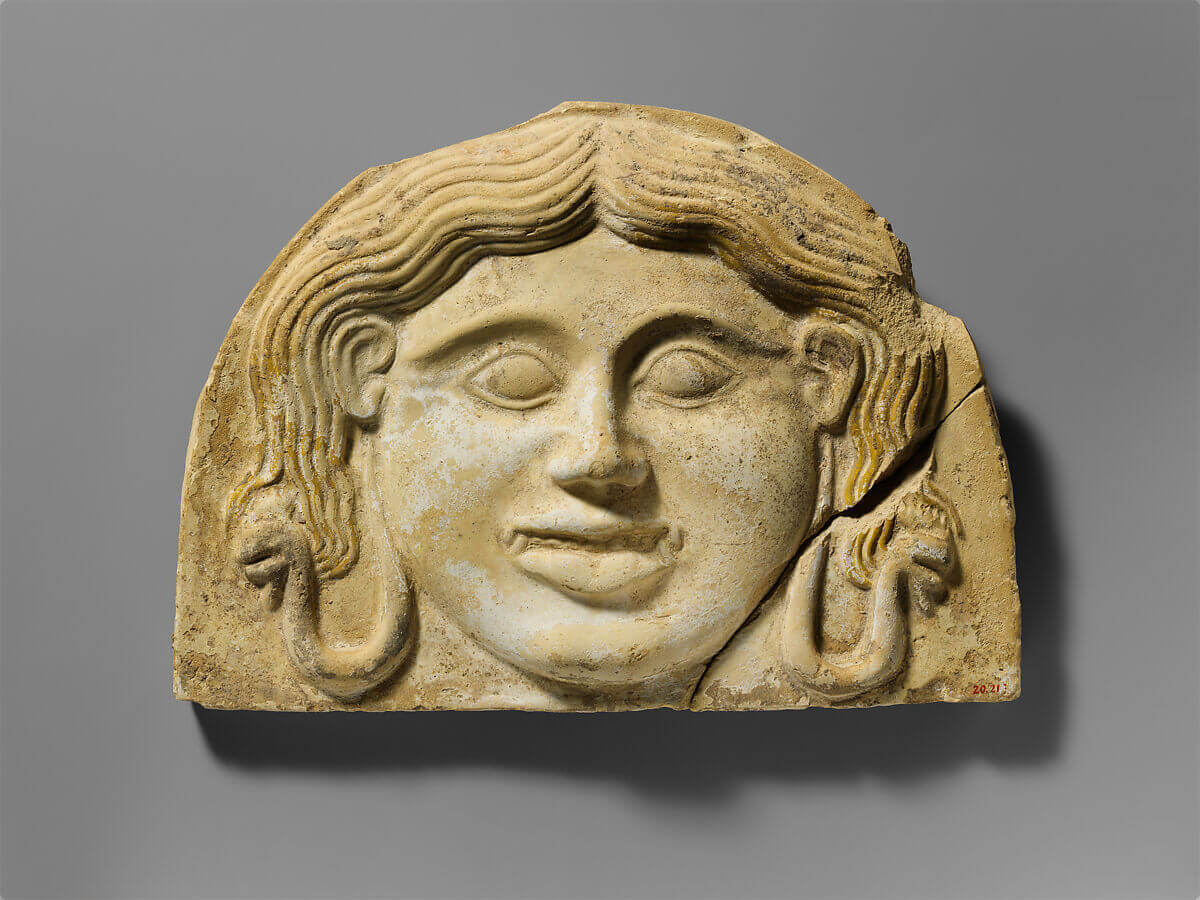
THE GORGONEION
One of the most recognizable protective images was the Gorgoneion, the head of the Gorgon Medusa. With her wide eyes, fierce expression, and hair made of twisting snakes, Medusa’s face was meant to be startling and unsettling. That was intentional. Greeks believed that displaying the Gorgoneion could frighten away harmful forces before they had the chance to cause damage. Rather than representing danger, the image came to function as a guardian.
The Gorgoneion appeared throughout the Greek world. It was painted on shields, carved into temples, molded into pottery, and worn as jewelry. Warriors carried it into battle. Families placed it near entrances to protect their homes. Wherever it appeared, the message was the same. This place was guarded. Archaeological examples of these symbols can still be seen today in major museum collections, including the Metropolitan Museum of Art in New York.
KATASKOPIA: A PROTECTIVE GESTURE
Symbols were not the only form of protection. The Greeks also practiced small gestures believed to ward off harmful influence. One such gesture was kataskopia, which involved pulling down the lower eyelid while looking at someone. The exact meaning is still debated by historians, but it was widely understood as a way of acknowledging the evil eye and guarding against its effects. It is a small detail, but it reveals something important. Belief in the evil eye was not limited to myths or religious rituals. It shaped everyday interactions between people.
ROMAN BELIEFS ABOUT THE EVIL EYE
The Romans inherited many ideas about the evil eye from Greek culture but expressed them in their own language and traditions. In Latin, the destructive force of envy was known as invidia. The word described both the emotion itself and the harmful influence it was believed to produce.Romans believed that envy could bring misfortune, illness, or sudden bad luck. Praise and admiration were not always harmless, and too much attention could easily provoke jealousy. Public figures were especially exposed to this danger. Successful generals, wealthy citizens, and popular leaders often attracted admiration and resentment at the same time. Because of this, Romans also developed their own protective symbols intended to guard against the effects of invidia.
THE FASCINUS: ROMAN PROTECTION AGAINST THE EVIL EYE
One of the most distinctive Roman protective symbols was the Fascinus, a phallic amulet believed to repel harmful energy. Although it may seem unusual today, the symbol was widely respected in Roman society as a powerful form of protection. Romans believed the Fascinus could deflect envy and neutralize the harmful effects of the evil eye. These charms were worn as jewelry, hung inside homes, or attached to objects for protection. Children were often given Fascinus amulets because they were thought to be especially vulnerable to negative attention. The symbol even appeared on military standards, suggesting that Roman soldiers sought protection not only from physical enemies but also from unseen forces.
WHY ANCIENT CULTURES FEARED ENVY
The widespread belief in the evil eye reveals something deeper about how ancient societies understood human nature. Envy was seen as one of the most dangerous emotions because it could easily lead to resentment, rivalry, and conflict. When one person’s success provoked jealousy in others, social harmony could quickly break down. The concept of the evil eye helped explain misfortune while also encouraging humility and restraint. If displaying too much wealth or success invited trouble, moderation became a practical form of protection. Symbols, gestures, and rituals offered reassurance in a world where unseen forces were believed to shape everyday life.
THE EVIL EYE IN MODERN TRADITIONS
Although ancient Greece and Rome disappeared long ago, belief in the evil eye never fully vanished. Across the Mediterranean, the Middle East, and parts of Latin America, many people still wear protective charms or display symbols believed to repel harmful energy. The familiar blue eye-shaped amulet is one of the most recognizable examples. Some traditions also include prayers or rituals meant to remove the effects of the evil eye and restore spiritual balance. These practices show how enduring the idea has been across centuries and cultures.
While these traditions have ancient roots, many people today still recognize the effects in more subtle, everyday ways. If you're curious how these influences ight show up in your own life, you can explore the signs and symptoms of the evil eye and how to recognize when something is off.
CONCLUSION
The evil eye held an important place in the cultures of ancient Greece and Rome. Known as Baskania among the Greeks and associated with invidia in Roman belief, it reflected a shared understanding of how powerful envy could be. To guard against this unseen force, people relied on protective symbols, gestures, and charms. The Gorgoneion, the kataskopia gesture, and the Roman Fascinus all served as forms of spiritual defense.
Even today, the ancient concern about jealousy and negative attention continues to shape spiritual traditions around the world. Through symbols, prayers, and protective practices, many people still seek protection from the same unseen forces that once concerned the Greeks and Romans.


